
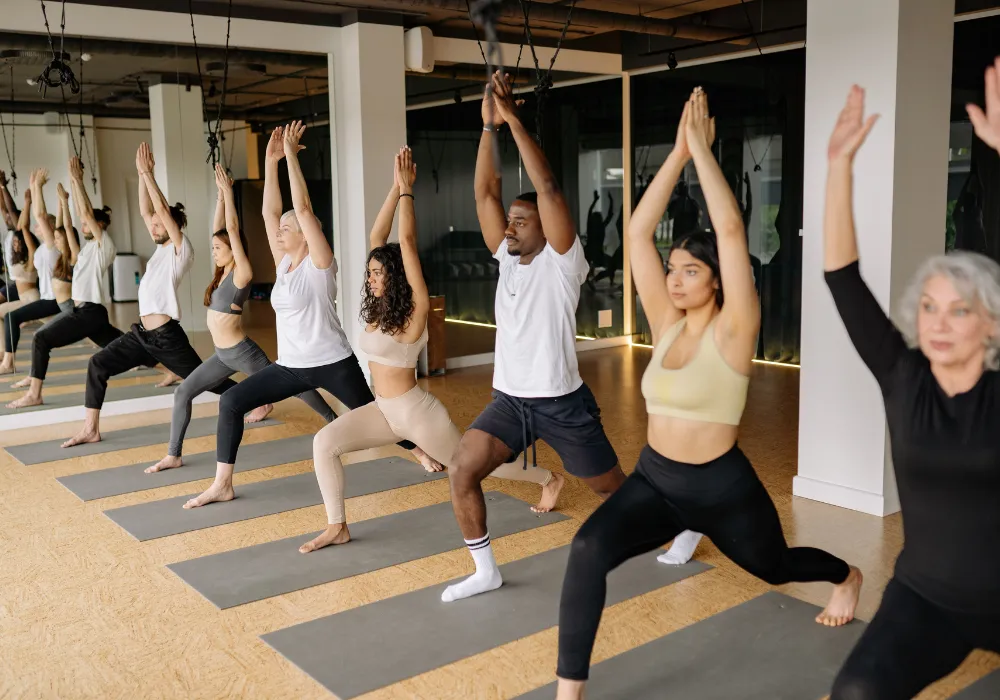
What is yoga, and how is it different from regular stretching?
Yoga combines held postures (asanas) with steady, controlled breathing. In each posture, the targeted and supporting muscles are engaged, and the breath is timed with the length of the pose and with the movement between poses. This links breathing to movement and challenges the whole body, not just one muscle group [1].
Yoga also has a mental side, with a deliberate focus on awareness of the self, the breath, and the body [2]. In a study of college athletes who all already stretched in their regular warm-ups, only the group that added yoga improved their flexibility. The athletes who relied on warm-up stretching alone did not [1].
Does yoga improve flexibility and balance in athletes?
It may. In a 10-week study of 26 male college athletes, soccer players who added two one-hour, instructor-led yoga sessions a week to their usual training improved their sit-and-reach score by about 1.8 inches and could hold a one-leg stork stand about 4 seconds longer.
The baseball players who did no yoga showed no significant improvement, and their scores were slightly lower at the end [1]. The yoga group also moved through a greater range in key positions, such as more ankle bend in a lunge and more hip and knee extension in a downward dog [1].
The study was small and preliminary, and the two groups played different sports and were not randomly assigned, so larger trials are needed to confirm the results [1].
Can yoga improve strength, endurance, and breathing?
Some studies suggest it can. Healthy adults who followed a 12-week hatha yoga program improved their VO2 max, a measure of how well the body uses oxygen during exercise [2].
In male football players, yogic breathing exercises added to training improved lung function and VO2 max, and yoga combined with self-myofascial release (a form of self-massage) improved flexibility and leg explosive power [2].
Yoga may not be the most effective way to build muscle mass or improve cardiovascular endurance, so it works best alongside your regular training [2].
Can yoga help prevent injuries?
It may help, but the evidence is indirect. Yoga is thought to lower two risk factors for injury: general tiredness and the feeling of being vulnerable to injury. It is also included in injury-prevention plans because of its effects on relaxation, core stability, mobility, and range of motion [2]. Athletes and coaches also see it as a way to prepare physically and mentally for competition [2].
The authors of the college athlete study suggest that the added flexibility and movement range from yoga may reduce the load placed on ligaments and joints [1]. Yoga is best seen as one part of a prevention plan rather than a guarantee against injury.
Can yoga help with stress, anxiety, and focus?
Athletes and coaches commonly use yoga to improve focus, control emotions, and visualize competition performance [2]. Yoga is thought to work partly by increasing parasympathetic activity (the body's rest mode) and lowering the body's stress response [2].
A small study of 40 national- and international-level athletes tested Yoga Nidra, a guided deep-relaxation practice, for 8 weeks alongside regular training, with 3 to 4 sessions a week of 30 to 45 minutes. It reported lower stress, better emotional control, lower cortisol (a stress hormone), and higher heart rate variability [3].
Most of this evidence comes from small studies and athletes' own opinions, so larger independent trials are needed. Yoga is not a replacement for professional care, and anyone with severe mental health concerns should see a qualified professional [2].
Is yoga useful for recovery after hard training or injury?
Athletes use yoga breathing exercises after matches and competitions to help the body settle back to normal [2]. Athletes and coaches also see yoga as useful in rehabilitation for problems such as muscle strains and orthopedic conditions, although these are opinions rather than trial results [2].
In the small Yoga Nidra study, athletes reported less mental fatigue and improvements in their recovery time [3]. If you are injured, see a physiotherapist first so that your exercises fit your injury.
How often should athletes do yoga, and when?
There is no single proven schedule. In the college athlete study, the yoga group did two one-hour, instructor-led sessions a week for 10 weeks, held in the morning before other physical activity [1].
In the Yoga Nidra study, athletes did 3 to 4 sessions a week of 30 to 45 minutes for 8 weeks [3]. Many athletes also use yoga and yogic breathing before and after training and competition [2]. The right schedule depends on your sport, training load, and any injuries, so it is best planned with your coach or physiotherapist.
Can yoga replace an athlete's regular training?
No. In the referenced studies, yoga was added on top of athletes' normal training, not used in place of it [1]. Yoga may not be the most effective way to build muscle mass or improve cardiovascular endurance [2].
In the college athlete study, the athletes who only did their usual training did not improve their flexibility or balance, which is where yoga added value [1].
References
1. Polsgrove, M. J., Eggleston, B. M., & Lockyer, R. J. (2016). Impact of 10 weeks of yoga practice on flexibility and balance of college athletes. International Journal of Yoga, 9(1), 27–34. https://doi.org/10.4103/0973-6131.171710
2. Bucea-Manea-Țoniș, R., & Păun, D. G. (2024). Yoga, a mindfulness therapy to prevent PTSD as to encompass athletes' performance. Frontiers in Psychology, 15, 1334278. https://doi.org/10.3389/fpsyg.2024.1334278
3. Karthika, J. (2025). The role of Yoga Nidra in mental resilience and performance consistency in elite athletes. Journal of Yoga, Sports, and Health Sciences, 1(1), 39–44. https://doi.org/10.17051/JYSHS/01.01.06

Heath Matthews Physio brings you better health and fitness through technology and expertise.
Heal, Achieve, Succeed with HMP