How common is acupuncture among athletes?
Use varies widely. Reported use ranged from 2.2% of college athletes in Palestine to 61% of professional football players in the Netherlands, where it was mostly dry needling for groin injuries [1]. In a US survey of sports medicine physicians, 58.4% of respondents had prescribed acupuncture, although only 11% of those contacted replied [1].
Athletes use it mainly for delayed-onset muscle soreness and musculoskeletal injuries, and both athletes and healthcare providers generally view it positively [1]. These figures come from small, self-reported studies, so they show how popular acupuncture is rather than how well it works.
What injuries and conditions can acupuncture help with?
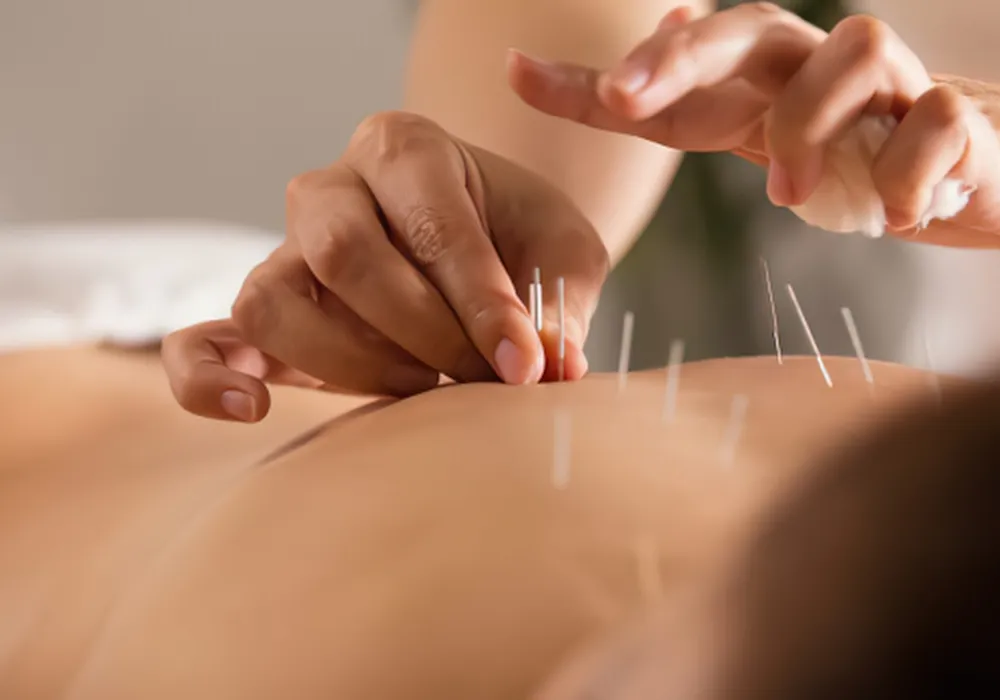
Sports medicine physicians who prescribe acupuncture most often use it for low back pain, followed by muscle strains and tears, tendinopathy (tendon problems), and ligament sprains [1].
However, the evidence that it works is mixed. A systematic review of randomized trials in adults with muscle, tendon, and joint problems in the arms and legs (not only athletes) found inconsistent results with small effects [4].
In single trials, traditional needle acupuncture worked better than exercise for Achilles tendinopathy (64 people), and electroacupuncture may have worked better than placebo for shoulder injuries (130 people).
Acupuncture gave no important benefit over placebo for upper-limb pain or over no treatment for pain around the kneecap, and the results for dry needling in plantar fasciitis (heel pain) were equivocal [4].Smaller studies in athletes found that adding acupuncture to standard care gave better results.
In 38 recreational athletes with plantar fasciitis (heel pain), those who added acupuncture to standard care (ice, rest, anti-inflammatory medication, and stretching) had greater reductions in pain and disability over three months than those who had standard care alone [2]. In 45 sports dance athletes with waist injuries, combining acupuncture with Western medical treatment gave a higher clinical efficacy rate (95%) than acupuncture alone (84%) or Western treatment alone (90%) [2].
Trials with weaker methods tend to overestimate benefits [4], and researchers say more randomized controlled trials in athletes are needed [1].
Can dry needling be used before or after competition?
Some sports clinicians use it around games, but the evidence is limited. In a commentary by sports physical therapists and a physician, the authors describe a quick in-and-out technique before a game as a passive warm-up to activate muscles, to be used together with, not instead of, a normal on-field warm-up. After a game, needles may be left in for a set time to ease pain and calm the nervous system [3].
Small studies reported an immediate improvement in vertical jump in healthy college students, and in ballet dancers an increase in plantar flexion torque (the force used to point the foot) with no change in pain or range of motion [3]. The authors note that dry needling has mostly been used in the subacute and chronic phases of injury, that its acute use rests partly on clinical experience, and that more research is needed to confirm that it works [3].
Can acupuncture help with pre-competition anxiety?
Possibly, but the evidence is limited. Some studies in adolescent athletes found lower competition anxiety, particularly worry-related (cognitive) anxiety, with acupuncture than with sham acupuncture.
However, results for other measures, such as skin conductance and body (somatic) anxiety scores after treatment, were conflicting [2].
Is acupuncture safe?
Serious problems are rare, with severe adverse events estimated at as few as 5 per 1 million treatments [2]. Minor side effects are common, though.
In a placebo-controlled trial of dry needling for plantar fasciitis, minor, short-lived side effects occurred in 32% of needling sessions compared with under 1% of sham sessions. The most common delayed effects, appearing 1 to 7 days later, were bruising and a temporary flare-up of symptoms, and there were no serious adverse events [4]. In the adolescent football study, 55% of players reported minimal effects such as mild focal numbness or tingling, and there were no major adverse effects [5].
Among serious complications, infection from poor sterile technique, such as reusing needles, is the most common, and it is uncommon today because disposable needles are widely used [2].
Rare but more serious events include a collapsed lung (pneumothorax) and nerve injury, which have mostly been linked to practitioners with limited training in anatomy [2]. Needling close to joints carries a higher infection risk [2]. The risks and contraindications have not been well studied in athletes specifically [2].
Tell your practitioner about your medical history and any recent injury or surgery, and choose one who is trained in anatomy and uses sterile, single-use needles.
Does acupuncture hurt, and how many sessions does an athlete need?
Some athletes worry beforehand about pain, bruising, or soreness [1]. The sensations during treatment range from warmth to numbness and aching [2], and bruising or a temporary flare-up of symptoms can follow in the days after [4].
In small trials, most athletes rated the experience as good or excellent and none rated it poor, although one reported local discomfort on a single treatment day [1]. Schedules in studies varied widely, from a single session after a race, to 15-minute sessions on up to 5 treatment days for muscle soreness [5], to a session every other day for 4 weeks for muscle pain syndrome [1].
Your practitioner will tailor the plan to your injury and goals.
Can acupuncture replace physiotherapy or rehab?
No. Acupuncture is best seen as a complement to conventional care, not a replacement.
Combining acupuncture with standard treatment gave better results than standard treatment alone [2]. Reviewers recommend using it together with Western therapies [2] and describe it as a complementary approach in the overall management of pain [1].
References
1. Chaabna, K., Jithesh, A., Cheema, J., Aboughanem, J., & Mamtani, R. (2024). Western medical acupuncture perception and use for pain management among athletes: A systematic review. Journal of Pain Research, 17, 357–366. https://doi.org/10.2147/JPR.S441869
2. Pujalte, G. G. A., Malone, M., Mandavalli, A., Phrathep, D. D., Shah, N. P., & Perlman, A. I. (2023). Acupuncture in sports medicine. Journal of Acupuncture and Meridian Studies, 16(6), 239–247. https://doi.org/10.51507/j.jams.2023.16.6.239
3. Gregory, T. J., Rauchwarter, S. A., & Feldman, M. D. (2022). Clinical commentary: Rehabilitation using acute dry needling for injured athletes returning to sport and improving performance. Arthroscopy, Sports Medicine, and Rehabilitation, 4(1), e209–e213. https://doi.org/10.1016/j.asmr.2021.09.035
4. Cox, J., Varatharajan, S., Côté, P., & the OPTIMa Collaboration. (2016). Effectiveness of acupuncture therapies to manage musculoskeletal disorders of the extremities: A systematic review. Journal of Orthopaedic & Sports Physical Therapy, 46(6), 409–429. https://doi.org/10.2519/jospt.2016.6270
5. Luetmer, M. T., Do, A., Canzanello, N. C., Bauer, B. A., & Laskowski, E. R. (2019). The feasibility and effects of acupuncture on muscle soreness and sense of well-being in an adolescent football population. American Journal of Physical Medicine & Rehabilitation, 98(11), 964–970. https://doi.org/10.1097/PHM.0000000000001226

Heath Matthews Physio brings you better health and fitness through technology and expertise.
Heal, Achieve, Succeed with HMP